US Stock Options:
From Beginner to Master
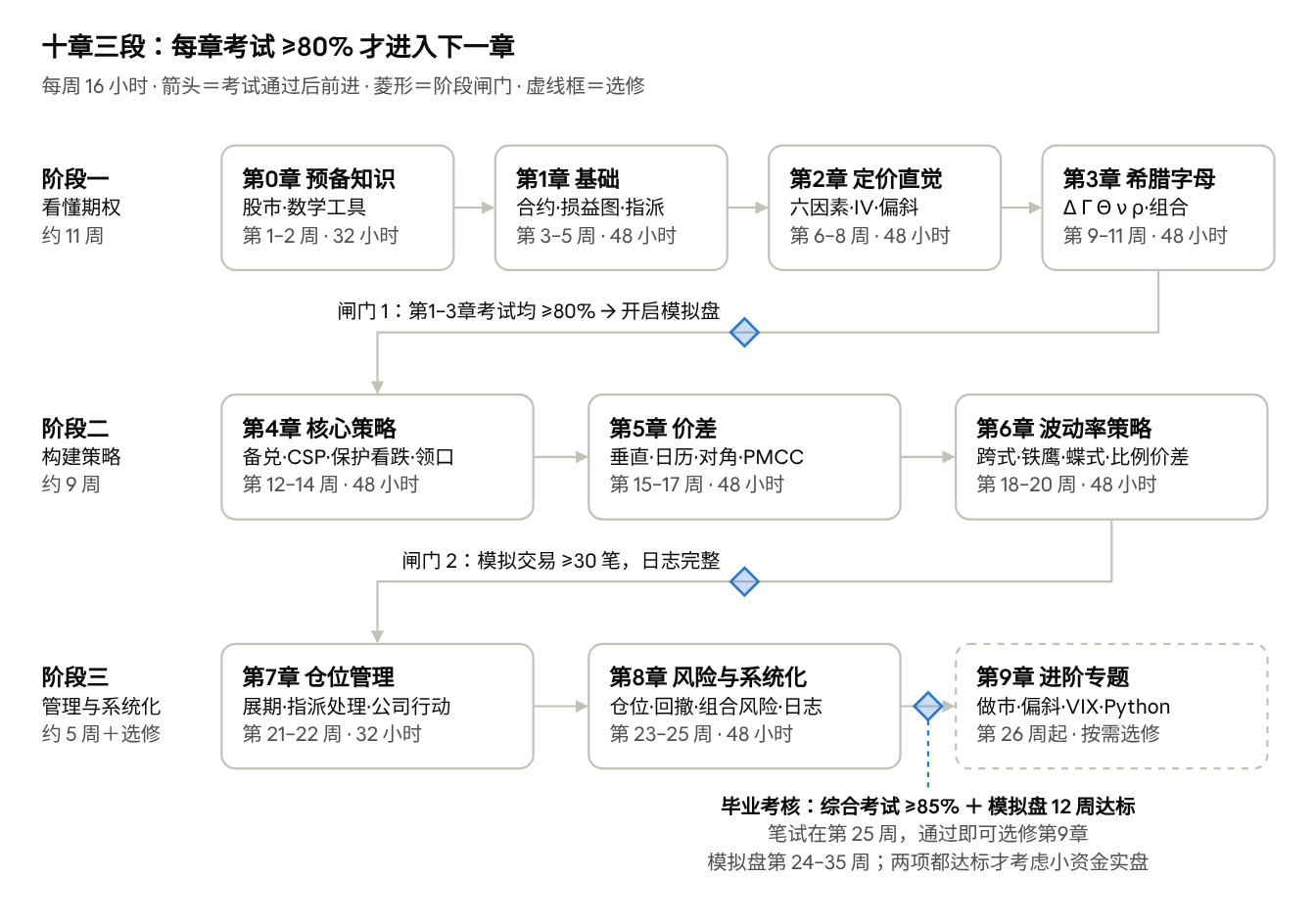
Ten chapters, about 25 weeks at 16 hours a week. The extra time goes into depth, not speed — plain-language lessons, examples you work by hand, practice after every module and paper trading from Chapter 4.
Continue learning
How to use this site
Section titled “How to use this site”- Read the syllabus first: the three stages, the three gates and how the 16 hours of each week are spent.
- Start every chapter on its overview page. The quick guide at the top gives the chapter goal, the weekly rhythm, the hands-on tasks, what it takes to pass, and a progress checklist you can tick.
- Study every module in the same loop: understand → work the examples (many modules also have a Try it yourself interactive chart — drag the sliders and watch the numbers move) → answer “Think about it” (answers start blurred) → do the practice block at the end, then practise with new numbers (checked instantly; problems you get wrong go into your mistake log) → tick “I finished this module”.
- Before starting anything new each day, spend 10–15 minutes on the review page: the term and formula cards that are due, and the mistakes to redo today.
- Stuck? Use Ask an AI tutor at the end of every module: copy the prompt into Claude or another AI assistant and it will tutor you one-to-one by the course’s rules. Wherever the lessons mention a “tutor”, an AI can play that part; the chapter overviews also have prompts for the weekly quiz and a mock chapter exam.
- Finish each chapter with the training questions and the chapter exam; you need 80% to move on. Answers are on the answers page.
- Terms with a dotted underline show their English name and a plain-language meaning when you hover or tap them; the full list is in the glossary. For situations you meet in real markets, see the scenario library.
The ten chapters
Stage 1 · Understanding options
Ch. 0 · Prerequisites2 weeks · 32 h — How the stock market works, plus the maths toolkit every later chapter uses: percentages, standard deviation, probability and compounding.
Ch. 1 · Foundations3 weeks · 48 h — Calls and puts, buyers and writers, strikes and expirations, intrinsic and extrinsic value, payoff diagrams, exercise and assignment.
Ch. 2 · Pricing intuition3 weeks · 48 h — The six drivers of an option’s price, time decay, implied versus historical volatility, IV rank, skew, earnings IV crush and put–call parity.
Ch. 3 · The Greeks3 weeks · 48 h — Delta, Gamma, Theta, Vega and Rho: what each one measures, how it moves with price, time and volatility, and how to add them up across a position.
Stage 2 · Building strategies
Ch. 4 · Core strategies3 weeks · 48 h — Long calls and puts, covered calls, cash-secured puts, the wheel, protective puts and collars. Paper trading starts here.
Ch. 5 · Spreads3 weeks · 48 h — Debit and credit verticals, calendars and diagonals, and why a spread is usually a better tool than a naked option.
Ch. 6 · Volatility strategies3 weeks · 48 h — Straddles, strangles, iron condors, butterflies, ratio spreads, gamma scalping, event trades and volatility shocks.
Stage 3 · Management & systems
Ch. 7 · Position management2 weeks · 32 h — Trade plans and exits, rolling, closing versus holding, delta hedging, assignment, corporate actions, expiration day and tax records.
Ch. 8 · Risk & systematization3 weeks · 48 h — Expectancy, position sizing and Kelly, drawdown control, portfolio Greeks, stress tests, journaling, backtesting and the graduation exam.
Electives
Ch. 9 · Advanced topics1–2 weeks per topic — Electives, each ending in a project: the market maker’s view, skew, event structures, VIX products, 0DTE, Python, higher-order Greeks and tail hedging.